Thursday, December 11, 2014


No Pain, No Gain…In Species Diversity
Close your eyes and imagine it is 200 hundred years ago. What do you think about? Perhaps a horse and buggy heading down Main Street? Maybe even sepia tone, old timey photos? Something that may or may not have come to mind is the change in the Midwestern landscape. In the early 1800s, Iowa was made up of mostly tallgrass prairie with an abundance of animals and diverse vegetation. Today, the countryside no longer resembles the scenic prairie, as the vast majority of the land has been converted into cropland. Before you begin to cry, don’t worry! All is not lost. Ecologists have been working to restore the tallgrass prairie at different sites in Iowa. Interestingly, while the restorations have been successful, it has been difficult to increase the diversity of vegetative species to the level of diversity achieved by the remnant native prairie. I’m particularly curious about how a disturbance, such as soil compaction, affects the diversity of species. Given the lack of research that has been done, I secretly (and now not so secretly) wonder if this could be the key that unlocks greater diversity in restored prairie.
A visual comparison of Iowa land cover in (A) the mid-1800s and (B) as of 2001.
Photo credit: http://armi.usgs.gov/story/story.php?contentid=1630
 
I acted on my detective impulses and found a paper that could shed light on the effect of soil compaction on the tallgrass prairie via bison wallows. The paper is entitled, “Potential Impacts of Bison Wallows on a Restored Tallgrass Prairie Community” by Miller et al., 2014. The researchers sought to investigate the effects of bison wallows on “weedy” versus “non-weedy” vegetation. Weedy plants have been defined in previous literature as more tolerant to disturbance, whereas non-weedy plants have been defined as less tolerant to disturbance. Bison wallows are a natural disturbance that leave large “bald patches”, as a result of the large animal rolling around on the ground and compact the soil in the process. The research was conducted in Jasper County Iowa at the Neal Smith Wildlife Refuge where there are a heard of Bison present. They randomly sampled 7 wallows and 7 non-wallows along a transect, while controlling for elevation, proximity to each other, and proximity to nearby perennials. Of particular interest to me is their findings related to the vegetation inside versus outside the wallows. Ultimately, the authors found that the results support the presence of a disturbance gradient. The gradient favored weedy species near disturbance and vice versa. Given that the adjacent prairie tended to have lower weedy plant cover, it is possible that the soil compaction of the bison wallow enables weedy-er species to flourish. On the flip side, the adjacent prairie enabled the success of the non-weedy species. This suggests that different degrees of soil compaction are necessary to have both weedy and non-weedy species thrive. 
A bison in the process of leaving a wallow.
Photo credit: Mary Jane Gibson
This raises certain questions about prairie restoration. Specifically, how feasible is larger scale soil compaction and would it help increase diversity enough to justify the cost? How important is increasing prairie diversity?! Should we even try restore the prairie to how it was 200 years ago?!! The larger questions are current conundrums to not only me, but also all restoration ecologists today. Restoration ecology is challenging in that even if the goal is to restore the land back to the way it was hundreds of years ago or more, it simply may not be possible. What factors contribute to the possible impossibility? Of course, humans are culpable for disrupting and modifying certain ecosystems, but this is only one piece of the puzzle. In fact, there are many factors that can contribute to changing landscapes, such as cyclical climate change and natural extinction of various species. In attempting to convert cropland back into tallgrass prairie, the impossibility of increasing species diversity exists, even if we know all there is to know about restored prairie. Similarly, we have ethical dillemas to consider as well, in thinking about how much humans should alter current ecosystems to try to achieve restoration goals. There may come a time when we need accept failure of restoration to historical standards and perhaps modify ecological restoration goals.    
 
Reference
Miller, Kimran, et al. "Potential Impacts of Bison Wallows on a Restored Tallgrass Prairie Community." Proceedings of the North American Prairie Conference. Vol. 23. 2014.

Expanding Killer Whale Distribution in the Arctic with Melting Ice

          As the world’s oceans warm from global climate change, marine organisms have to adjust to altered habitat conditions and subsequent changes in population dynamics. As temperate waters warm, certain species are able to move further towards the poles where suitable conditions now exist. With the invasion of species into new waters, previously established marine populations are in threat of being outcompeted for resources or becoming prey to unfamiliar predators. These consequences of climate change are apparent in Artic regions, where rising temperatures are decreasing ice coverage, allowing normally ice-avoiding species to disperse further North than in previous decades. As high latitudes are expected to show the most pronounced effects of climate change, scientists are beginning to study how organisms and ecosystems are changing in these increasingly ice-free areas.
One species benefiting from decreased ice coverage in Artic waters is Orcinus orca, or the killer whale. Though found almost globally, killer whale populations differ from one another with their specific environmental adaptations, dietary habits, and geographic range, resulting in what are called different ‘ecotypes.’ Residential ecotypes exclusively prey on fish, while the transient ecotypes, or ‘visiting’ populations, will only prey on marine mammals such as seal, sea birds, and other whales. Though these transient ecotypes hunt along ice edges, sometimes even flipping small ice floats to overturn resting seal, they tend to avoid the larger, heavier ice surfaces.

Two killer whales about to flip over an ice float a seal is resting on. (http://e360.yale.edu/images/features/antarctica_killer_whales_seal_e360.jpg)

Because of this ‘ice-avoidance’ behavior, killer whale distribution is usually restricted geographically and seasonally, dependent upon the surface ice cycle; though sea ice is prevalent year-round in some areas, surface ice generally breaks apart or melts in August, and reforms by November. However, with increasing temperatures, this melt-reform cycle no longer occurs in some areas, decreasing habitat availability to ice-adapted marine mammals and potentially increasing accessibility to species such as the killer whale. As killer whales are an apex predator, or a predator at the very top of the food chain, their expanded distribution in the Arctic may have a significant impact on pre-existing population dynamics. It is therefore important to see whether sea ice reduction really is redistributing the transient ecotypes, a question Jeff Higdon and Steven Ferguson addressed in their paper ‘Loss of Arctic sea ice causing punctuated change in sightings of killer whales (Orcinus orca) over the past century’ (2009.)
In their study, the authors compiled historic data on July sea ice concentration in the Canadian Arctic from 1900 to 2006 and reported killer whale sightings in the Hudson Bay region for the same time period. They found that, since 1900, the number of killer whale sightings per decade increased exponentially while median ice concentration over time showed a significantly declining trend. In sum, they found that ice concentration in the Hudson Strait was negatively correlated with the number of killer whale sightings reported per decade, as well as with the range of sightings. This means that with receding ice coverage in the Hudson Strait, killer whales are no longer spatially restricted, seen more frequently in areas further west than ever before.
Median ice concentration from 1902 to 2004 taken from three areas of the Hudson Strait (Western, Central, and Eastern.) All three areas show a significant decline in ice concentration.

Due to its apex status, the killer whale’s increased range poses as a top-down ecosystem force. In other words, its recent expansion in places like the Hudson Strait will result in a significant increase of predation on whales and seals, which will decrease their predation on other species. Since sea ice is predicted to decrease even more within the next few decades, the killer whale’s distribution will most likely continue to expand, impeding upon the habitats of other apex predators such as the polar bear, who rely on high ice concentrations. Higdon and Ferguson conclude by predicting that with this expanded distribution, killer whales will most likely replace polar bears as the dominant predator of the Arctic, changing the marine mammal community in this environment.
With global climate change, the distribution and abundance of organisms will change drastically. This study is just one example of how a predator’s range expansion has the potential to drastically change an entire ecosystem’s community dynamics, and similar shifts should be expected in the future. It has been projected that within the next 50 years, surface ice coverage in the Arctic may eventually be non-existent, making it even more pertinent to study the potential effects this will have upon species’ presence and abundance. Though it now seems inevitable that species such as the killer whale will continue moving North, learning of the consequences now may better prepare us for future management of fisheries that will be impacted as well as form potential conservation plans for species in these rapidly changing environments.

Reference:
Higdon, J.W, Ferguson, S.H. Loss of Arctic sea ice causing punctuated change in sightings of killer whales (Orcinus orca) over the past century. 2009. Ecological Applications

19(5): 1365-1375

Finding Home in a Fragmented Landscape: Pollinator Population Dynamics

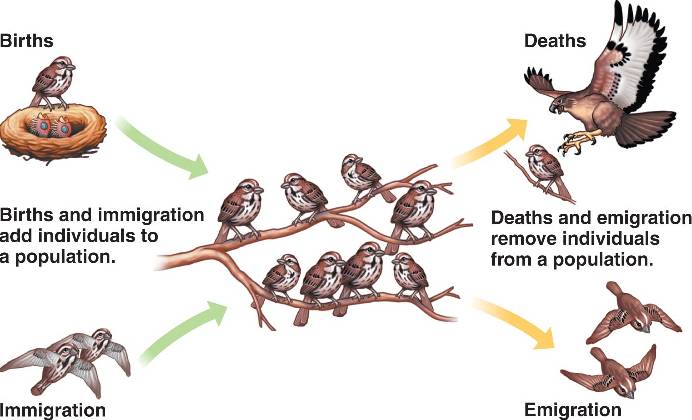
The way that a group of individuals of the same species interacts over time in a certain defined space can be called population dynamics. Population dynamics of a certain species can be driven by both interactions with individuals of the same species (intraspecific interactions) and with individuals from other species (interspecific interactions). Populations are also dependent on resources like space, light, water, or food, and have a carrying capacity, the number of individuals that a habitat can support due to limited resources. Some populations can also grow and interact with resources and other species differently when they are below a certain threshold size or density. A good understanding of species population dynamics can help us understand species’ distributions – why a species is found where it is.  When habitats become fragmented by natural disturbances like fire and earthquakes, or manmade disturbances like agriculture and construction, the effects on population dynamics can be complicated. Understanding these effects is critical in conservation efforts.
Births, deaths, immigration, and emigration, which add up to population size, are all influenced by competition among individuals and between species for resources like space, light, water, or food. <http://bio1152.nicerweb.com/Locked/media/ch53/53_03PopulationDynamics-L.jpg>.

This study manipulated different aspects of fragmented orchard meadow habitats in the Leine-Weser region in southern Lower-Saxony, Germany, from 1998 to 2003, and observed the response of populations of Osmia rufa, a solitary bee, and its natural enemies, in order to tease apart the effects of habitat fragmentation and to determine which are the most influential on bee population dynamics. They hypothesized that there are three main factors: nesting resources, pollen availability, and natural enemies. O. rufa is a solitary mason bee that nests in pre-existing holes in twigs or logs, or in hollow plant stems. They are fairly general feeders. Their enemies include a variety of parasites, most of which attack larvae in the nest. In order to quantify and compare these three factors, the researchers placed artificial nests in the center of each meadow, and then each winter (when the larvae were dormant) the artificial nests were retrieved to determine birth, mortality, and parasitism rates. Population growth rate was compared with habitat connectivity and area as well as parasitism and mortality rates.
This study provided strong evidence that nest availability has a bottom-up controlling effect on O. rufa populations: after 5 years with artificial nests, populations grew to be, on average, 35 times larger. Food availability had no significant impact on populations, even when they were hugely inflated by the presence of artificial nest sites. However, the authors speculate that more specialized feeders could be limited by food availability. They found that small populations were more vulnerable to parasitic enemies and hypothesized that this is because in denser populations, it is less likely that nests will be left totally unguarded when parents leave to forage. This is important because it suggests that dwindling populations already limited by lack of nesting sites are increasingly threatened by predators as their numbers shrink. Regarding the effects of spatial aspects of habitat, the scientists found that although the bees are capable of migrating much farther than their typical foraging distance of less than one kilometer, about 80% of females built their nests at the same site where they were born.

Cross-section of an O. rufa nest. These bees construct partitions between each larvae and fill each chamber with pollen.  <http://upload.wikimedia.org/wikipedia/commons/8/87/Osmia_rufa_nest.jpg>


                Although similar studies have been conducted about larger herbivores, this piece sheds light on the population dynamics of pollinators. Red mason bees are particularly economically important, as they are widely managed to pollinate orchards.  While this study finds that providing these bees with nesting material increases their population, it cannot speak to other, more specialized bees that are more dependent on native plants. For these bees, spatial arrangement and food availability may be more crucial to population dynamics, so strategic placement of food or nesting resources along corridors or in way stations could be a management option to preserve other more species that are more threatened by the effects of habitat fragmentation.

References:
Steffan-Dewenter, Ingolf and Susan Schiele. 2008. Do Resources or Natural Enemies Drive Bee Population Dynamics in Fragmented Habitats? Ecology 89(5): 1375-1387. http://www.esajournals.org/doi/pdf/10.1890/06-1323.1

Links:
More information on solitary bees and bee conservation: http://www.xerces.org/pollinator-conservation/native-bees/#


Wednesday, December 10, 2014

One Fish, Two Fish


               Chances are you wouldn’t be happy if someone broke into your house and started eating all your food, and just generally trashing the place. So you can see why invasive species are such a pressing issue in ecology. Invasive species are species that have been introduced or have found their way somewhere they didn’t originally live, and can sustain a population. In many populations of invasive species, they do quite well for themselves. There are many historical cases of invasive species taking over an area and drastically changing the environment and trophic webs of that area. For instance, rabbits were introduced into Australia in the 18th century and experienced a massive population boom. They quickly became pests, eating all of the crops grown in the area and generally messing things up. So it is clearly important to have methods in place to deal with possible invasive species. But how do we know where we need to be vigilant? From what? This issue is addressed in a research article by Poulos et al.
Image of a Northern Snakehead
http://upload.wikimedia.org/wikipedia/commons/f/f8/Snakehead_-_Channa_argus_2.jpg
               They set out to find out what factors influence the distribution of three invasive fish species, the northern snakehead (Channa argus), round goby (Neogobius melanostomus), and silver carp (Hypophthalmichthys molitrix). In order to do this, they used a modeling tool called species distribution modeling (SDM). SDM is used to generate a map of potential habitat for a species based on presence or presence/absence (abundance) data, as well as environmental factors. There are many different types of species distribution models, and to get a more accurate read the authors decided to use ensemble modeling. This type of modeling uses multiple models, and combines them to see where all of them are in agreement. The authors use data gathered from the Nonindigenous Aquatic Species (NAS) Database for their species presence data, and data gathered from several other databases for their environmental variables. Then, using the appropriate software, they ran their models. This generated their habitat predictor maps, which they combined for each species of fish. They found that for northern snakeheads, the best habitats for invasion were those with low elevation, slow-flowing waters, with emergent vegetation (plants that live in water but grow partly out of the water). The most ideal habitats for round goby populations to invade were areas in higher latitudes with high canopy cover and forested shorelines. Lastly, they found that silver carp liked areas with slow-flowing water, low sand content, and not very much vegetation.
               So how do we use this information to better the field of ecology? What purpose do these maps serve? Well, with home-burglarizing fish swimming around we really have to be careful about what types of fish we release into new habitats. Having maps of possible habitats of these fish lets us devise strategies for protecting areas of high risk for invasion. Without them these fish may just be running around, so to speak, wherever they want. If we want to preserve what’s left of the natural ecosystems around us, a good place to start is with preventing harmful invasive species from setting up shop.

Reference:
Poulos, H., Chernoff, B., Fuller, P., & Butman, D. (2011). Ensemble forecasting of potential habitat for three invasive fishes. Aquatic Invasions, 7(1), 59-72. http://www.aquaticinvasions.net/2012/AI_2012_1_Poulos_etal.pdf

Chinook Salmon: Responses to an Increasingly Hostile Environment

            As temperatures continue to rise around the world, due to global climate change, organisms are being forced to face new challenges that threaten their survival. These changes in the environment can have severe consequences for population dynamics and the distributions of organisms. This means that warming temperatures, that induce thermal stress in organisms, can cause changes in the size and age make-up of populations by altering factors such as mortality, growth, and behavior. Additionally, rising temperatures can change the distribution or spread of organisms in an area because higher temperatures may be more suitable for certain species and allow them to expand the range in which they are usually found, while higher temperatures may also cause thermal stress in other organisms and severely limit their survival and range. Many scientists have studied the ways in which organisms will respond to different facets of climate change, however, more research is needed to predict how multiple environmental stressors, that result from climate change, may affect organisms and ecosystems.
            One species that is already being affected by climate change and will continue to experience detrimental effects due to rising temperatures is Oncorhynchus tshawytscha, or Chinook salmon. Specifically, juvenile Chinook salmon, which are both economically and ecologically important in the western United States, are facing the dual threat of rising temperatures and invasive predation by smallmouth bass. Not only are rising temperatures inducing thermal stress in these young organisms, but they are also facilitating the migration of invasive smallmouth bass further upstream into juvenile salmon habitat. In order to study the “Costs of living for juvenile Chinook salmon in an increasingly warm and invaded world,” Dr. Lauren Kuehne and her colleagues studied the interactive effects of rising temperatures and smallmouth bass predation on mortality, behavior, physiology (or the normal function of living organisms), and growth (Kuehne et al. 2012).
http://commons.wikimedia.org/wiki/File:Chinook_Salmon_(Oncorhynchus_(%3Dsalmo)_tshawytscha)_(12435393153).jpg

            In this study, the authors conducted 48-hour trials in artificial stream channels for four treatment groups: (i) warm+ predator (ii) warm+ no predator (iii) cool+ predator (iv) cool+ no predator. Kuehne et al. found that there was no increase in predation in warmer temperatures; however, they did find that the combined environmental stressors caused significant effects on the growth, physiology, and behavior of the juvenile salmon. More specifically, they found that salmon in the warm+ predator treatments showed the lowest growth compared to the other treatments. They also found that plasma glucose and plasma cortisol levels, which are commonly used to measure physiological stress responses in fish, were higher for the salmon in the warm and predator treatments compared to the reference treatment (cool+ no predator). Finally, they found that anti-predator behavior (such as swimming in groups and decreased swimming time) were highest in the warm+ predator treatment. Therefore, even though the combined stressors did not affect mortality (predation), these stressors are likely to have significant sub-lethal effects for juvenile salmon as climate change persists.

            The findings of Kuehne et al. add to current scientific knowledge, regarding climate change, by examining how an important and endangered species may be affected by the interaction of multiple environmental stressors brought on by the changing environment. This research has implications for the ways in which changing distributions of species and thermal stress will interact to impose sub-lethal constraints on organisms. These sub-lethal effects have harmful implications for salmon and will likely impact their growth and development, resistance to disease, and mortality in the longer term.  These effects could lead to changes in the population dynamics of Chinook salmon and more research is needed to find out what kind of long term effects these environmental stressors will have on ecologically and economically important juvenile salmon.

Reference:

Kuehne, L.M., Olden, J.D., Duda, J.J. Costs of living for juvenile Chinook salmon (Oncorhynchus tshawytscha) in an increasingly warming and invaded world. 2012. Canadian Journal of Fisheries & Aquatic Sciences 69(10): 1621-1630. doi:10.1139/f2012-094.