Sunday, October 27, 2019

A Tale of All Cities: Why the Urban Ecological Perspective is Essential to Landscape Management and Architectural Development


      Prairie lands have been diminished significantly throughout the world as a result of urbanization and agriculture. The development of built environments has long been dominated by architecture and civil engineering, which lack a holistic approach that seeks to enhance the natural environments and their effect on human well-being. This has produced structured environments focus on aesthetic appeal, that fail to enhance the natural landscape in which the structure was erected, leading to issues of soil erosiondecreased resilience toward natural disasters and increased abundance of invasive species. Throughout the late 20th century many studies were published supporting the fundamental imperative of instituting ecological perspectives in the development of architecture within urban settings, which has sparked growing interest in sustainable design and landscape ecology (McPhearson et al. 2016). However, much of the application of these views have only focused on the function of a single plant species effect on variables like stormwater runoff yet fail to see how the integration of an ecological approach can lead to a far more productive environment. 
    In the article The ecological imperative for environmental design and planning by Steiner et al. (2013), the authors discuss how crucial it is that ecological perspectives be included in the development of architecture in urban settings in conjunction with city planning, civil engineering, and urban design. Architecture historically has focused on aesthetics, form and object making, viewing the environment as merely a setting for development to take place, not as something that engages with the architecture. This mechanistic view can be effective in designing a bridge or treating water pollution but fail to consider the external impacts and the consequences of such developments. Urban design represents the intersection between planning, landscape architecture, and ecology, however, the focus of urban design has been almost exclusively on policy concerns, resulting in planners maintaining a poor understanding of the physical world and it’s the relation to the regional ecology of an area (Niemelä 1999). The authors advocate for changing how urbanism is conceived, shifting to a focus on landscape and ecology first, rather than traditional urbanism, which emphasizes transportation and built structures. This shift will not only enable architects to understand the role of organisms within the urban environment but also will allow for the transition from the study of design and construction to initiating the development of built systems that optimize ecological function (Pickett et al. 2016) Ecologically developed designs have been shown to produce improved function, marketability, and provide economic benefits by mitigating the negative impacts of natural disasters, improving the health of the environment by regulating water supply, erosion and sediment control, and often provide cultural and recreational benefits as well.
Sampling of target species P. arenastratum along a sidewalk in South Campus of Grinnell College.
    This article has large implications for our study on landscape management as it relates to campus ecology. In this study, we will look at how methods of landscape management have led to the presence of invasive species Polygonum arenastrum, a native European noxious weed along sidewalks throughout the Grinnell College campus. Much of the development that has taken place on campus has been done without ecological implications in mind and has led to increased propagation of invasive species, surface runoff, and degradation of the environment. By studying the abundance of this invasive species, we hope to understand how management practices including snow plowing, mowing, and planting of ornamental species that do not support our regional environment in conjunction with increased surface runoff, as disturbance events lead to the establishment of this invasive species. Through applying concepts of urban ecology, city and regional planners will aim to provide evidence for why architectural and landscape designs that emphasize ecological stability focusing on hydrology, soils, and biodiversity in our environment can lead to a more sustainable future.

References
McPhearson, T., Pickett, S. T. A., Grimm, N., Niemelä, J., Alberti, M., Elmqvist, T.,… Qureshi, S. (2016, February 24). Advancing Urban Ecology toward a Science of Cities. BioScience, Volume 66, Issue 3, 01 March 2016, Pages 198–212.
Mutel, C. F. (2018, December 21). Iowa's Biodiversity: A Look to the Past and Into the Future: Guest Essay. Iowa Public Television: Iowa Land and Sky. http://iptv.org/iowalandandsky/story/32704/iowas-biodiversity.
Niemelä, J. (1999, January )Ecology and urban planning. Biodiversity and Conservation (1999) 8:119. https://doi.org/10.1023/A:1008817325994
Pickett, S. T. A., M. L. Cadenasso, D. L. Childers, M. J. McDonnell, and W. Zhou. (2016, July 16). Evolution and future of urban ecological science: ecology in, of, and for the city. Ecosystem Health and Sustainability 2(7):e01229. doi:10.1002/ehs2.1229.
Serpell, O. (2018, November 28). Wrong About Urbanization? How Emerging Factors Could Shift People Away From Cities. Kleinman Center for Energy Policy. https://kleinmanenergy.upenn.edu/policy-digests/wrong-about-urbanization.
Steiner, F., Simmons, M., Gallagher, M., Ranganathan, J. and Robertson, C. (2013, September 1). The ecological imperative for environmental design and planning. Frontiers in Ecology and the Environment, 11: 355-361. doi:10.1890/130052. https://esajournals.onlinelibrary.wiley.com/doi/full/10.1890/130052

Can you find fungi on your campus?


            What is the likelihood that you would stumble across a mushroom on your daily walk through the quad? Well, ectomycorrhizal fungi (ECM) have been used to answer this question. For reference, ECM fungi are organisms that form mutualistic relationships with various tree species, as they are essential for nutrient and carbon cycling within forest ecosystems (Anderson and Cairney, 2007).  Urban environments are constantly subjected to disturbances, and ECM fungi are highly sensitive to disturbances (Hiu et al., 2017). The study of ECM fungi within an urban environment is crucial for us to understand if disturbances affect species richness, diversity, or distribution; therefore, the study of ECM fungi response to disturbance in an urban environment allows us to determine if disturbances affect ECM fungi distribution.
Russula nobilis, an example of an ectomycorrhizal fungi found under beech trees.

Researchers Hui et al. conducted a study that compared distribution differences of ECM fungi across boreal forest environments and urban green spaces; they analyzed how ECM fungi and host - tree interactions affected species distribution. They compared how ECM fungal communities were affected by different plant species interactions, conifer and broadleaf trees, park age, and environment, control forests or urban parks. ECM fungi were sampled from 41 urban parks in southern Finland, and 5 control forests in Lahti; moreover, fungi were sampled using a DNA extraction method, and fungi DNA were analyzed using the Fragment Analyzer (Advanced Analytical, USA). Their data suggested that the species richness in urban parks was similar to their sampled control forests, but that ECM communities differed between conifer and broadleaf trees. In fact, they found that ECM communities changed over time under conifers, but ECM communities under broadleaves did not. This led them to conclude that the tree species – fungal interaction determines ECM distribution rather than disturbances (Hiu et al., 2017).
We have conducted a similar ecological study, but we analyzed saprophytic and mycorrhizal fungi distribution on Grinnell College’s campus (Grinnell, Iowa). Our study maps fruiting bodies to identify where Grinnell’s fungi are located. In our study, we analyze the distribution of all fruiting bodies; however, Hiu et al.’s results indicate that ECM distribution in urban environments is affected by tree species – fungal interactions (Hiu et al., 2017); these results can aid us in understanding the ECM fungi distribution on Grinnell’s campus. We can use the results of Hiu et al. to create a hypothesis, do different tree species of Grinnell’s campus exhibit different ECM fungal communities?  If we can support our hypothesis, then we can conclude that Grinnell College’s ECM fungi distribution is not affected by disturbances, but the distribution is affected by tree species – fungal interactions; however, it is possible that we can not support our hypothesis, as disturbance may play a role in Grinnell’s ECM fungi distribution.
An unidentified fungus of the genus Scleroderma, an ECM fungi, found on Grinnell’s campus.
References:
·         Anderson, I. C., Cairney, J. W. G. (2007). Ectomycorrhizal fungi: exploring the mycelial frontier. FEMS Microbiology Reviews, 31, 388-406.
·         Hui, N., Liu, Z., Kotze, J., Jumpponen, A., Francini, G., Setala, H. (2017). Ectomycorrhizal Fungal Communities in Urban Parks Are Similar to Those in Natural Forests but Shaped by Vegetation and Park Age. Applied and Environmental Microbiology, 83, 1-12.
·         Kuo, M. (2011, July). The Genus Scleroderma. Retrieved from https://www.mushroomexpert.com/scleroderma.html 26 October, 2019
·         Nature, F. (2019). Russula nobilis Velen. - Beechwood Sickener. Retrieved from https://www.first-nature.com/fungi/russula-nobilis.php 17 October, 2019

Tuesday, October 22, 2019

Weedy and the Tramp(ling)


Crys Moosman


Grinnellians like to take the path of least resistance. Give them an article to read, and they’ll skim the abstract, introduction, and conclusion. Put a heavy door in front of them and they’ll use the handicap button to automatically open the door. Build them a sidewalk to get from the East campus residence halls to the JRC, and they’ll walk straight across the lawn. This is exactly how the various social trails around Grinnell College’s campus have formed over the years, and with each new step, the ground becomes slightly more disturbed. With disturbance comes altered vegetation cover and soil compaction, both of which play a significant part in determining the richness and distribution of the trailside plant communities. If you go out to the social trails on campus, you’ll be able to see the difference between the trailside vegetation and the vegetation growing five meters away - the trail is patchy, with tendrils and leafy clumps scattered among clover-speckled grass, while the distant vegetation is made up of thick clover-speckled grass (Figure 1).


Figure 1. A) The relatively undisturbed turf grass and clover (Trifolium repens) three meters away from the social trial on East Campus. B) The immediate trailside is patchy and scattered with broadleaf plantain (Plantago major), knotgrass (Polygonum arenastrum).

            Trailside vegetation variation as a result of trampling is not just a phenomenon that occurs on college campuses in rural Iowa. The impacts of trampling are present in urban woodland pathways, national park mountain trails, and grassland trail systems,  to name a few (Littlemore and Barker 2001; Nepal and Way 2007; Potito and Beatty 2005). In attempts to gain a better understanding of the effect of trail usage on trailside vegetation, many researchers have completed vegetative analysis of trail corridors. One such experiment was completed by Aaron Potito and Susan Beatty (2005) in public grassland trail systems in Boulder County, Colorado. In this experiment, Potito and Beatty examined the establishment patterns of trailside vegetation on four recreation trails of various usage levels and ages in hopes of better understanding how exotic and ruderal species abundance and density is influenced by trampling.  To determine the presence of ruderal, exotic, non-ruderal, and native plant species, they set up multiple transects parallel to each trail. For each transect they identified present plant species and determined the percent coverage of each species.
            What could parallel transects alongside these hiking trails possibly show about the impact of trampling on species establishment? Multiple things, it turns out. First, the trailside has more bare ground and a greater presence of exotic and ruderal plants than ground 25 meters or more from the trail. Potito and Beatty found that the percent coverage of ruderal species decreased from 15% near the trail to 5%, 25 meters away from the trail (Figure 2). Similarly, exotic species exhibited 37% coverage on the immediate trailside and 10% coverage 25 meters away. Native and non-ruderal plant coverage did not differ, but trailside species were more interspersed with exotic and ruderal plants than species away from the trailside. The trailside had 10% more bare ground than spaces away from the trail. Below, figure one from Petito and Beatty’s piece provides a visual representation of the percent coverage of ruderal, exotic, non-ruderal, and native species.


Figure 2. Percent cover of different vegetation classifications for trailside transects versus transects away from trailside for established trails (**significant at 0.01 level using one-tailed t-tests). Error bars represent the 95% confidence interval for the means. (Adapted from Petito and Beatty 2005).

            Second, trail sides had altered species richness. There was a 35% reduction in native species and a 46% reduction in non-ruderal species in addition to a 24% reduction in the overall presence of plants along the trailside. The number of ruderal and exotic species present did not differ from the edge of the trail to 25 meters beyond the trail. Potito and Beatty explain this by proposing that trail corridors reorganize local vegetation in a manner that favors ruderal and exotic plants over non-ruderal and native plants, thus decreasing the abundance and richness of native and non-ruderal plants alongside the trail.
            The last notable thing Potito and Beatty determined in their observations was the increased rate of establishment of ruderal and non-native plants along trails. This suggests that non-native and ruderal plants are more capable of growing in disturbed and compacted soils than native and non-ruderal plants. It also explains the reduced presence of non-native and ruderal species away from the trailside - where there is minimal disturbance, there is reduced opportunity for these plants to preemptively outcompete the native and non-ruderal species.
            Let’s jump back to Grinnell College, where my lab partner, Vishva, and I are trying to figure out how the student-made social trails around campus are affecting the surrounding vegetation. Upon a quick scan of the compacted trails, we identified five different plants: turf grass, clover (Trifolium repens), broadleaf plantain (Plantago major), knotgrass (Polygonum arenastrum), and dandelion (Taraxacum officinale). Both broadleaf and knotgrass are considered a weed. The turfgrass and clover were abundant both on the immediate trailside and everywhere else on the lawn. But knotgrass and plantain seemed to be abundant only near the trails, and usually within a half a meter of the center of the trail (Figure 1). To try to gauge the vegetation coverage of trails, Vishva and I measured plant coverage every five meters using 2 meter (200 cm) transects that were perpendicular to the social trail. All five species previously identified were accounted for in our transects. Turf grass and clover were found along many transect points, from 5 cm to 200 cm. On the other hand, invasive plants were never found beyond 175 cm. This suggests that knotgrass and broadleaf are able to establish themselves well when the ground has been disturbed, and are less successful in less trampled sections of the lawn.
Though our research is still in progress, both our preliminary research and the research completed by Potito and Beatty implies that in order to successfully reduce the abundance and success of invasive and ruderal species, management practices need to encourage narrow trails and minimal trampling beyond the edges of the trails. Places similar to the grasslands in Boulder County can encourage users to stay on defined trails. Meanwhile, Grinnell College can encourage its students to use the sidewalk was constructed for the purpose of student walking.

References

Littlemore, J. and Barker, S. (2001). The ecological response of forest ground flora and soils to experimental trampling in British urban woodlands. Urban Ecosystems. 5: 257. 


Nepal, S.K., Way, P. (2007). Comparison of vegetation conditions along two backcountry trails in  Mount Robson Provincial Park, British Columbia (Canada). Journal of Environmental Management. 82:240–249. 


Potito, A.P. and Beatty, S.W. (2005). Impacts of recreation trails on exotic and ruderal species distribution in grassland areas along the Colorado Front Range. Environmental Management. 36:230. 


Sunday, October 20, 2019


Spontaneous Urban Ecology
Vince Eckhart, Waldo S. Walker Professor of Biology

I once heard a Grinnell alum, now a highly accomplished professor of biology at another institution, remark that “ecology” education at Grinnell used to mean driving away from campus several km to the field station (CERA), ignoring the agricultural landscape in between. The unspoken lesson seemed to be that there was no “ecology” to be done in that landscape—that ecology’s subjects (organism distribution, abundance, adaptation, and biogeochemistry) only “happen” in “natural” areas. Not so, of course.

That alum’s experience was before I arrived at Grinnell. I admit that in > 20 years of teaching ecology and other field biology courses here, most field trips in my classes are to CERA. Sometimes, though, our field trips don’t involve driving at all, not even to the farm fields.

The BIO 368 (“Ecology”) student blog posts that follow spotlight published papers on urban ecology and relate them to students’ ongoing projects, projects that address ecological questions on the Grinnell College campus. To give an example that didn’t happen, if I were studying the distribution of Platanus occidentalis (“sycamore”) seedlings on campus in fall, 2019, I might have some things to say. I might mention that 2019 followed what appeared to be a mast seeding year for P. occidentalis and impressive wind dispersal during the windy winter of 2018-2019. I might feature the recent article by Omar et al.  (2018), which showed that trees of the genus Platanus in urban areas create patches of inhospitable habitat for other “spontaneous” urban flora, possibly because their leaf litter contain inhibitory chemicals, allelopathy.

But I’m not studying that, though I want to, and I won’t describe that article, though I could. My students, however, completed the assignments like I asked them to. 

Platanus occicentalis on Grinnell’s campus, winter 2018-2019, before the snow came and seemed never to leave.

Close-up view of the carpet of seeds under the tree at left.


Omar, M., Al Sayed, N., Barré, K., Halwani, J., & Machon, N. (2018). Drivers of the distribution of spontaneous plant communities and species within urban tree bases. Urban forestry & urban greening35, 174-191.

Tuesday, November 20, 2018

The Search for Macrofossils within Pete the Peat

by Nick Alex, Lauren Frankel, and Sean Wright

Imagine Grinnell, Iowa 29,000 years before the present (ybp). Instead of seas of corn and soybeans as far as the eye can see, the landscape was comprised of spruce forests and patches of sedge wetlands. While this may sound more like the current day wilderness of Alaska or Canada, cycles of glaciation brought boreal forests south to Iowa. Particularly, the maximum glacial extent in Iowa came from the Des Moines lobe of the Laurentide ice sheet, which covered the north-central region of the state approximately 13,800 ybp (Clayton and Moran 1981). This period of glacial advance followed a spell of minor warming and glacial retreat from 27,000-30,000 ybp (Dyke et al. 2002). Where Grinnell College stands today, about 29,000 ybp one such sedge wetland accumulated plant material in the water only to be uncovered thousands of years later...


Fast forward to the spring of 1960. Grinnell College was undergoing a very familiar process to us: campus construction. The college was building a new fine arts building, the Roberts Theatre. As the Grinnell College students who had the esteemed privilege of witnessing the serene and peaceful Alumni Recitation Hall property get turned into a muddy hole in preparation for the construction of the new Humanities and Social Sciences building know, campus construction has a way of exposing history that has not been seen in ages to the open air (take the Peace Rock for example). This is exactly what happened when the construction of Roberts Theater exposed a deep and extensive peat deposit, tentatively estimated to be 29,000 years old. About 5 meters below surface level, lay a peat deposit, holding the key to understanding the biota of this region prior to anthropogenic alterations to the environment. Peat is a mixture of partially decomposed plant material that has accumulated in a water-saturated environment in the absence of oxygen. In these environments, the greatest plant material accumulates where the temperature is high enough for plants to grow but too low for large amounts of microbial degradation. Peat samples are of particular interest of geologists and palynologists who use the deposits to provide both direct and indirect evidence of interglacial climate and biota.

Picture of the exposed peat during the construction of Roberts Theatre in 1960 (Graham 1962).

One of the ways we can learn more about our peat is to look for evidence of past organic life. This can often be seen as fossils, or in our case macrofossils. Despite the name, these macrofossils need not be large in size but are still expected to be larger than pollen grains. Our aim was to dig through the peat to look for macrofossils such as fragments of vascular plants or bryophytes that could tell us more about the vegetation of the land when the peat was deposited. In the initial work conducted when the peat was discovered, it was primarily pollen and wood fragments “characteristic of northern coniferous forest” that were extracted from the peat (Graham 1962). Because of this, there is more to learn about the plant composition from the examination of macrofossils, including non-woody plants or plants with limited pollen dispersal abilities. 


To examine the peat, we had to decide on a method for first picking apart the portions of peat we were working with, and then further breaking it down to search for macrofossils under dissecting microscopes. The original piece of peat (colloquially called Pete) that we started with was broken down using a rock hammer and a smaller pick in order to split the peat apart and decide pieces that were to undergo further analysis. Once the large pieces of wood were split off and given to the wood group, we placed the smaller pieces of peat into zip sealed bags, eventually to be further broken down in water or potassium hydroxide (KOH) solution and screened through mesh sieves to search for macrofossils under compound microscopes (Faegri et al. 1989, Baker 1996). Once potential macrofossils were found and separated, we placed them on slides for microscopy imaging analysis. We then compared the microscopy images of our macrofossils to previously published and identified macrofossil assemblages.


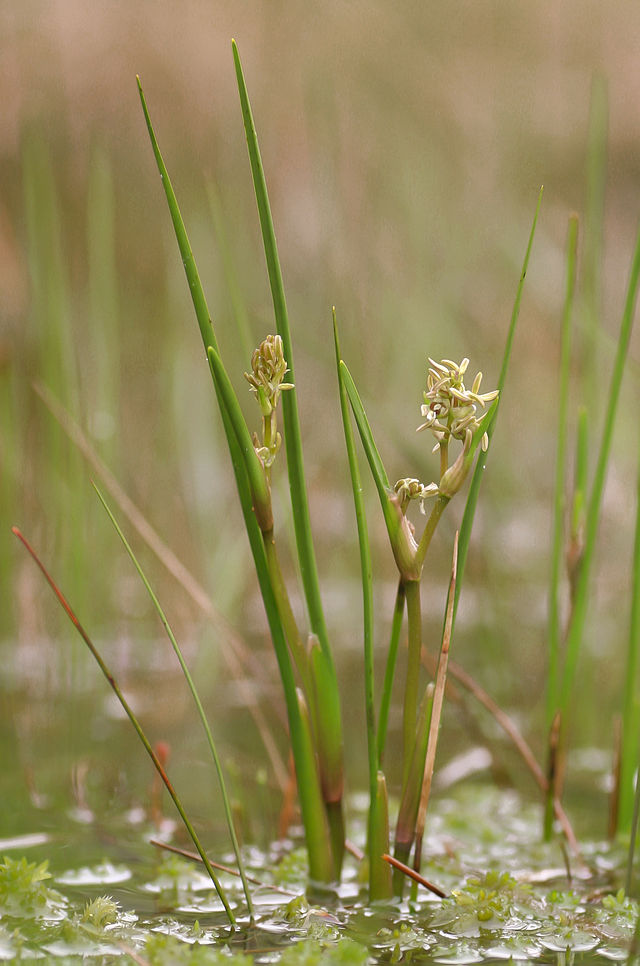
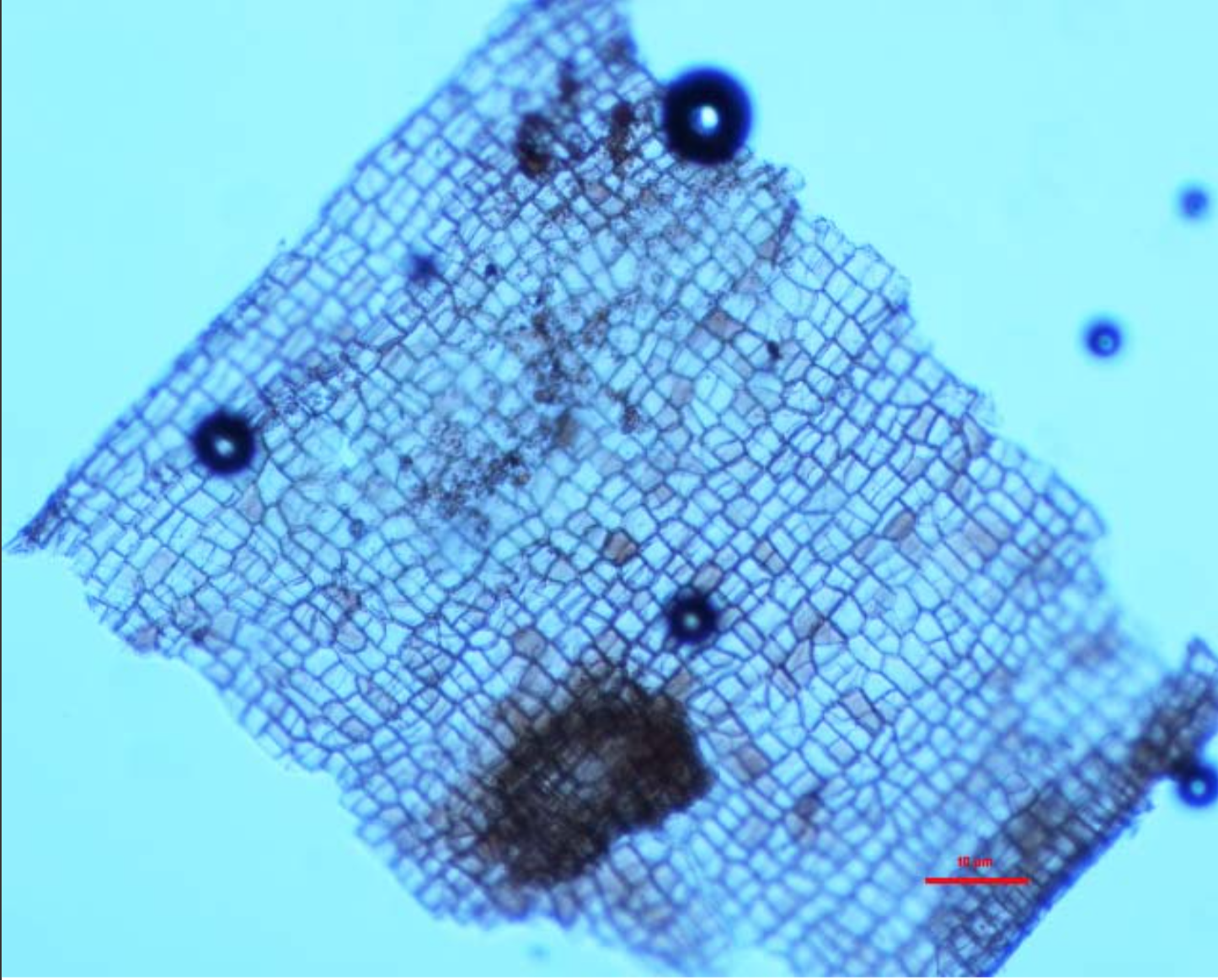
Left: our potential Scheuchzeria palustris rhizome epidermis tissue. Right: Scheuchzeria palustris flowering in the Netherlands (picture from Wikipedia user Bertblok).

We found many macrofossils with an array of rectangular cells about 600 microns long but lacked any indication of stomata, expressed by doughnut-shaped pores used during photosynthesis, leading us to believe this plant tissue was not photosynthesizing. After comparing to Mauquoy & Van Geel 2007, we concluded they were instead rhizome (horizontally growing, underground stem) epidermis from Scheuchzeria palustris, a plant typical of bog and fen waters. At a much lower abundance than S. palustris, we also found plant tissues that displayed some similarity to Betula fusca leaf tissue. However, this sample lacked stomata, as well, and thus were probably stem or root tissue. 


Unidentified stem or root tissue isolated from the Grinnell peat.

These findings lead us to believe that the landscape of Grinnell ~29,000 years ago contained sedge wetlands, the kind of ecosystem conducive to the growth of S. palustris. Sedge wetlands seem like a far cry from the current expansive agricultural operations of corn and soybeans, and grasslands that we see driving around Iowa today. Despite our lack of evidence for a spruce forest, there may have been patches of coniferous forests interspersed with sedge wetlands similar to the composition of Kearney, Nebraska, about 600 km away and also near the southern edge of the Laurentide ice sheet, about 23,000 ybp (Dillon et al. 2018). In the future, an increased reference collection would be of great use to compare macrofossil and wood samples produced from the peat to better understand the paleoenvironment of Grinnell.


Works Cited
Baker, R. G., Bettis III, E. A., Schwert, D. P., Horton, D. G., Chumbley, C. A., Gonzalez, L. A., & Reagan, M. K. (1996). Holocene paleoenvironments of northeast Iowa. Ecological Monographs, 66(2), 203-234.
Clayton, L., & Moran, S. R. (1982). Chronology of late Wisconsinan glaciation in middle North America. Quaternary Science Reviews, 1(1), 55-82.
Dillon, J. S., Stolze, S., & Larsen, A. K. (2018). Late Pleistocene Pollen and Plant Macrofossils from a Buried Wetland Deposit in the Platte River Valley, South-Central Nebraska. Great Plains Research, 28(2), 173-183.
Dyke, A. S., Andrews, J. T., Clark, P. U., England, J. H., Miller, G. H., Shaw, J., & Veillette, J. J. (2002). The Laurentide and Innuitian ice sheets during the last glacial maximum. Quaternary Science Reviews, 21(1), 9-31.
Faegri, K., Kaland, P. E., & Krzywinski, K. (1989). Textbook of pollen analysis (No. Ed. 4). John Wiley & Sons Ltd.
Graham Jr, B. F. (1962). A post-Kansan peat at Grinnell, Iowa: a preliminary report. In Proceedings of the Iowa Academy of Science (Vol. 69, No. 1, pp. 39-44).
Mauquoy, D., & Van Geel, B. (2007). Plant macrofossil methods and studies: mire and peat macros. In Encyclopedia of quaternary science. Elsevier Science.

Monday, November 19, 2018

Unearthing the History of Iowa's Trees

Maggie Loery, Siri Bruhn, and Vishva Nalamalapu

Pop quiz! What is peat?… Not to worry, we didn’t know either until our professor brought a box of it to class, which his colleague had found in the basement of our college's science building. He explained that while peat may look like dirt, it’s actually organic material that has been poorly decomposed due to acidic or anaerobic conditions. It turns out that poor decomposition is good news for us, or for anyone else investigating life at the time the peat was deposited. Since our class, Evolution of the Iowa Flora, is all about understanding how plants in Iowa have changed throughout time, our professor explained that this peat could be a rich source for furthering this understanding.

The box of peat didn’t come with a whole lot of information, but our professor explained that Ben Graham, a former professor at our college, originally found the peat sixty years ago at a construction site on campus (Fig. 1). He published a preliminary report on the peat (Graham 1962) where he mentioned that the peat contained many wood fragments preserved in "cellulosic form," and identified some wood fragments as Tamarack (Larix larcina). He estimated the peat was deposited between 12,000 and 130,000 years ago, corresponding to the time between the early Wisconsin and Illinoian glacial stages.


Figure 1. Note in the box of peat

Once we selected a 24x16 cm chunk of peat to study, we fondly named it “Peter,” and gently began disaggregating it. We uncovered fragments of wood, as well as fragments of leaves and insects. Though we hoped to find pollen as Ben Graham did, we were sadly not able to. Thus, we split the investigation into three groups: Team Wood, Team Macrofossils, and Team Reference. While we, as Team Wood, tackled the identification of wood fragments, Team Macrofossils did the same for other plant fragments. Team Reference set out on a scavenger hunt to collect reference wood fragments from trees on campus. Our hope was if they visualized their reference samples with the same techniques as we used on our samples, we could compare the two and better identify the historic wood fragments.

We began by separating cells. Our professor explained that we could create a maceration fluid as described by Huang and Yeung (2015), which would separate the cells, allowing us to search for particular cell types and features that distinguish between trees. We had to macerate the samples for longer than expected as the components binding the cells were not adequately digested. And that was not the only complication we encountered. Preparing microscope slides involved carefully transferring small quantities of cells onto a block of gel on the slide, melting the gel, and then placing a coverslip on top (Fig. 2)… Easier said than done. The cells were often either not adequately digested or over-digested, and the slides often had bubbles that made the cells difficult to visualize. We should probably admit that we never did perfect this slide-preparation technique, but we did manage to make slides for seven of our samples that allowed us to view the features we were hoping to see.


Figure 2. Microscope slide preparation setup

Our identification relied on three cellular characteristics: bordered pits, helical thickenings, and the presence of vessel cells (Fig. 3). Bordered pits, which resemble donuts, but are far too small to eat, are abundant in gymnosperm tracheid cells. Helical thickenings are spiral ridges in tracheid and vessel cells. Angiosperms have small bordered pits compared to gymnosperms. Using the findings of Baker et al. on the composition of the flora of Iowa during the Holocene, we used the size of bordered pits to distinguish between three trees that grew in Iowa around the time the peat was likely deposited: larch, pine, and spruce (Baker et al. 1990). Spruce cells have bordered pits in a single row, pine cells have larger bordered pits in a single row, and larch cells have bordered pits in pairs. Vessel cells, which comprise long, water-conducting structures, are only present in angiosperms.


Figure 3. Our key to identify wood fragments

Keeping an eye out for these features, we visualized our microscope slides (Fig. 4). The wood fragments seemed to include larch, pine, spruce, and an angiosperm! We observed single rows of ~20 µm diameter bordered pits in the tracheids of three samples, leading us to believe these wood fragments were from spruce trees. Single rows of ~30 µm bordered pits of another sample led us to believe this wood fragment was from a pine tree. Pairs of bordered pits in tracheids of another sample indicated this wood fragment was from a larch tree (Fig. 5). We only found helical thickenings in one sample. They appeared to be on vessel cells and were dotted by bordered pits (~50 µm diameter), which indicated this wood fragment was from an angiosperm (Fig. 6).


Figure 4. Maggie and Siri visualizing microscope slides.


Although we originally intended to compare our images to Team Reference’s, many of their images showed structures we did not observe (i.e. bordered pit fields in vessel elements; Fig. 7). We were, however, able to see that the bordered pits on the pine tree reference (~50 µm diameter) were slightly larger than those on ours (~30 µm diameter), which could indicate mis-identification, or could simply represent an actual range of sizes.


Figure 7. Team Reference’s bordered pit field in a vessel element

Soon, we’ll have better information about the age of our peat too. In addition to our wood identification, we prepared and submitted three wood fragments to Beta Analytic for radiocarbon dating. We’ll let you know once we have a better idea of when these larch, pine, spruce, and angiosperm trees were inhabiting what is now Grinnell College!

So, in our two short weeks of analyzing “Peter’s” wood fragments, we found evidence that the Grinnell flora included larch, pine, spruce, and angiosperm trees when the peat was deposited. If you want to see what Iowa was like back then, drive a few hours up to northern Minnesota and imagine you’re instead in Iowa long ago. Compare the landscape you see to Iowa today, and consider the evolution from conifer woods to prairie to the acres on acres of corn and soybeans you see today. Studies like ours and that of Baker and colleagues allow us to understand how and when these changes took place. Our work is just the beginning; there is plenty of other work to be done, and there’s plenty of peat left to do it!


Works Cited
Baker, R. G., Chumbley, C. A., Witinok, P.M., & Kim, H. K. (1990). Holocene Vegetational Changes
in Eastern Iowa. Journal of the Iowa Academy of Science, 97, 167-177.

Hoadley, R. Bruce. (1990). Identifying Wood: Accurate results with simple tools. Newtown, CT: Taunton Press.

Graham, B. F. (1962). A Post-Kansan Peat at Grinnell, Iowa: A Preliminary Report. Proceedings of the Iowa Academy of Science, 69, 39-44.

Yeung, E. C. T., Stasolla, C., Sumner, M. J., & Huang, B. Q. (2015). Plant microtechniques and protocols. Springer International Publishing.

Sunday, November 18, 2018

References for Pete

A Short Investigation of a (Very) Long Paleobotanic History

Andrea Baumgartel, Emily Burgess, Isaac Ferber

Paleobotany is the study of historic plant communities and species using information gathered from preserved geological records of past environments. It’s important because it tells us about what our environment used to be like, like how plant morphology changes over time, how old a species is, and how ecological communities undergo change over time. Paleobotany can also give us clues about what we can expect as our climate changes in the current day by telling us what the ecological communities of an area were like in the past, and what the environment was like back then. It’s common for communities of plants, including many of Iowa’s own, to have cyclical patterns of population and distribution decline, and recovery in response to similar shifts in climate, among other factors. Paleobotanic studies can be done using fossilized plants or pieces of plants that have escaped decomposition in peat bogs, and still remain relatively intact after thousands of years.
            Several studies have been completed in Iowa using paleobotany to reconstruct past environments. In 1996 Baker et al. did an analysis of the floodplain alluvium (material deposited by a river over years of flooding) of Roberts Creek in northeastern Iowa to determine how the plant community surrounding the floodplain had changed over the last 11,000 years. They found that there was a succession of boreal forest, followed by deciduous forest, prairie, and oak savanna, leading in the modern agricultural area. This is a good example of how paleobotany can inform us on what the environments we live in used to look like, in terms of plants at least.
            During the construction of the Robert’s Theatre on Grinnell College Campus, a layer of peat was uncovered during excavation, and a preliminary analysis of what was preserved in the peat was done by Ben Graham in 1962, who found some wood fragments and pollen. The rest he left for us, and in this year’s Evolution of the Iowa Flora class we set out to see what else we could find and identify.
Our investigation didn’t involve the actual unearthing (or rather, un-peating) of the identity of the unknown materials in the peat (which we’ve affectionately named “Pete”) itself, but rather the crafting and imaging of already-known specimens (dubbed “reference materials”) that could potentially be, or be related to, said unknowns. Once the ancient unknown organic matter (e.g., small-to-microscopic wood bits, leaves, stems, pollen, etc.) is extracted from the peat, the reference materials can be used comparatively in order to help determine the identification of those unknowns.
While there are certainly a fair amount of available reference images existing online, it’s always advantageous to make one’s own reference materials, because 1) it helps to have consistent imaging methods and settings (i.e., the prep & imaging processes will be the same for both references and unknowns) and 2) you can never 100% guarantee that the reference identifications you find online are actually what they say they are. Also, we’ve collected reference materials from the actual location (Grinnell Iowa) that had the potential to be found in the peat, and thus the reference materials we find will be more directly relevant to this location’s past.
The reference materials in question are wood samples from the following tree genera, all located throughout the central most parts of Grinnell College’s campus: Alnus glutinosa (alder), Betula nigra (birch), Carpinus caroliniana (hornbeam), Fraxinus americana (ash), Pinus strobus (pine), Populus deltoides (cottonwood), and Tsuga caroliniana  (hemlock). Our imaging began with pollen samples collected earlier by professor Vince Eckhart, which ended up not being used, as numerous attempts to detect pollen within the actual peat itself were unsuccessful. However, we remain optimistic that pollen evidence will be found from the peat sample in the future, as the seminal paper by Ben Graham included notes verifying that the peat did in fact contain pollen, despite our findings.
With no ancient pollen to identify, our focus moved from creating pollen references (of which there is a fantastic online database anyway), and we shifted our goals to collecting wood from around campus, processing them in the same way as the peat fragments, and imaging it so the rest of the class could use our slides to identify their mystery wood. The first task was to search campus to collect samples from the modern equivalent of trees that might be in the peat. After a day of collecting, we broke down our samples, which were branch fragments, into small bits that fit into small vials. These were soaked in 5% potassium hydroxide (KOH) to break down the wood in the same way the peat was processed. After a week in the solution at a constant 45°C, we were ready to begin to make our slides for imaging. Just putting chunks of wood on a glass plate wasn’t going to cut it, so we needed to dye and divide the samples into pieces as small as possible, ideally to expose individual cells.
We didn’t find definitive literature on how to process specifically macerated wood samples into something microscope friendly, so we spent a day working to create our own method. The system that yielded the best results involved two slide plates, one for staining the wood cells with safranin (aka basic red 2), and the other for cleaning excess stain and cutting the wood into the smallest pieces possible in deionized (distilled) water. The newly stained wood was cleaned in deionized water, and after waiting for the water to evaporate, the sample was sealed in melted gelatin under a cover slide. Our best samples were permanently enclosed with clear nail polish. We imaged cells we identified as containing visible, important structures, specifically searching for vessel elements in angiosperms, along with helical structures, and border pits in gymnosperms (Figures 1 & 2). These parts were the most likely to be identifiable in the ancient wood collected from the other groups.


Fig 1. Modern Alnus glutinosa sample with visible vessel elements and perforation plate.


Fig 2. Modern Carpinus caroliniana sample with visible helical structures within a vessel element.


References

Graham, B. F. Jr. 1962. A Post-Kansan Peat at Grinnell, Iowa: A Preliminary Report. Proceedings of the Iowa Academy of Science 69: 39-44.


Baker, R.G., E. A. Bettis III; D. P. Schwert; D. G. Horton; C. A. Chumbley; L. A. Gonzalez; M. K. Reagan. 1996. Holocene Paleoenvironments of Northeast Iowa. Ecological Monographs 66: 203-234.


The Grinnell Peat: Preserved; Uncovered; Forgotten; Re-discovered; Explored.


For an undetermined number of years (not exceeding 58), a re-purposed cardboard box sat in the basement of the Noyce Science Center. Finding and opening the box, my faculty colleague Andrew Graham ("Graham A," whose position is in Chemistry and Environmental Studies) found: (1) several brick-sized clumps of dry soil, rich in organic matter, rather casually protected with heavy paper; (2) handfuls of sneeze-provoking dust; and (3) a copy of a 1962 scientific article written by beloved Grinnell Biology Professor Ben Graham (1920-2009; "Graham B"). 

In the article Graham B told the origin story of the box's contents. The construction of Grinnell College's Roberts Theatre in 1960 uncovered a 50 cm layer of soggy, compressed peat, 5 m below the ground surface. Peat deposits form in places like bogs, where acidity, lack of oxygen, and low temperatures hinder decomposition. In this way, active areas of peat formation represent "sinks" for carbon, while ancient deposits represent important sources of fossils. Recognizing that the deeply buried "Grinnell Peat" could reveal prehistoric plant communities, Graham B and his students sampled the peat. Graham (1962) was "preliminary report" of their findings, including a broad age estimate (300,000 - 20,000 years ago) and notes on the identities of fossil wood and pollen the peat contained. 

We don't yet know what fraction of the material Graham B and his students examined ended up in the mysterious, forgotten box, nor do we know when the packaging took place. We do think that the preliminary report had no sequel. Graham A graciously transferred the box to my care, recognizing my department's claim and imagining that my students might learn by attempting to expand Graham B's 1962 report. 

BIO 305 (Evolution of the Iowa Flora) includes a unit on the history of Iowa vegetation. Past students' research into that history, however, mainly consisted of field trips to sand prairies and other sites that reveal some of that history, and of spotlighting what other scientists had discovered. Blog posts from 2013 and 2015 document some of this work. In 2018 my BIO 305 students made some of their own discoveries, extracting and attempting to identify fossils from the Grinnell Peat, and making reference collections of contemporary plants for comparison. In the posts that follow, teams of students reveal some of their findings and what it took to discover them. Meanwhile, I pledge not to hide their source material in a mystery box in the basement.