Friday, December 12, 2014

The Disturbing Invasion of Sweet Clover


            Rocky Mountain National Park was established in 1915. Situated in Colorado, its main goal has been to preserve areas for the enjoyment of people. However, adding people to any environment tends to create disturbances. These disturbances, caused in part by the addition of roads, trails, and human activity, are called anthropogenic disturbances. Recent research has illuminated connections between the colonization of exotic species and these human disturbances, yet the impacts of these invasions on the native ecosystem are hard to quantify. Thus, Wolf et al (2003) investigate the impacts of sweet clover (Melilotus officinalis and Melilotus alba) invasion on the montane grasslands, specifically how invasive patches differ in species richness and community structure from control patches.
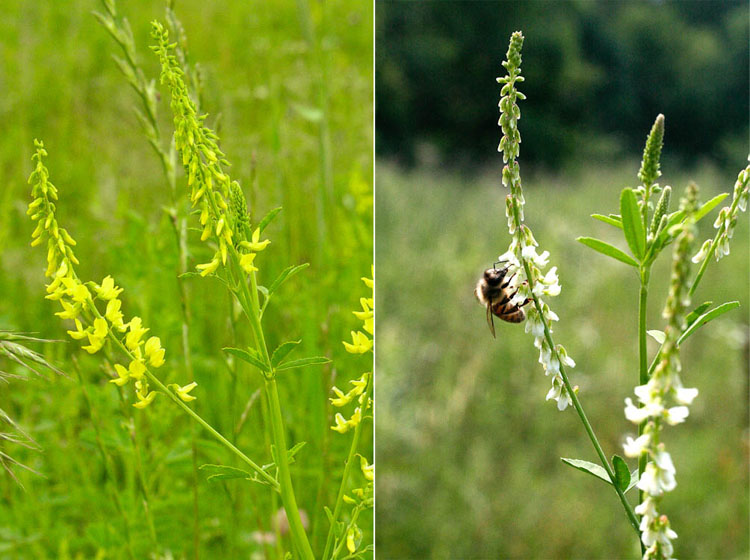

Images of Melilotus officinalis (left) and Melilotus alba (right) which are invasive species under examination in Wolf et al’s (2003) research. Image courtesy of http://ohioplants.org/wp-content/uploads/2012/04/Melilotus-officinalis-and-alba.jpg

            For their experiment, Wolf et al (2003) sampled areas that had been invaded by sweet clover, measuring each invaded patch’s total size. These patches were paired with an adjacent patch of comparable size that retained the native community (no invasives). Within these patches, the researches established plots to estimate the species cover and composition, noting also the percent cover of bare ground. Additional plots were placed along the edges of the invaded patches to look at the edge effects.
           
The researchers found several interesting relationships. First, total species richness varied as a function of time. Yet native species richness varied over the growing season while the exotic species richness remained the same. Second, invaded patches had a higher percentage of cover attributed to forbs where as the native patches had a higher percentage of grass cover. Third, more perennials were present in the control plots. The invaded plots had a higher richness of annual and biennial species (Figure 1). With respect to the edge experiments, Wolf et al found a gradient, with many of the aspects characterizing invaded plots concentrated at the center and diffusing outwards. Sweet clover spread 0.8m from the original patch boundaries in 1998 and 1.8m in 1999.


Figure 1: Summary of Wolf et al (2003) results from experiments comparing control patches to sweet clover invaded patches in Rocky Mountain National Park.


            The findings of Wolf et al signify the potential for sweet clover invasion to change the community composition of native systems. These differences in species richness and composition may be due to life history characteristics of sweet clover or inherent competitive advantages in comparison to native species. These different interactions, introduced by sweet clover colonization, may induce community composition shifts. The fact that patches invaded by sweet clover were dominated by exotic species is frightening, as it may indicate that invasion fragments existing native communities. Therefore, the invasion of an exotic species may constitute a different type of anthropogenic disturbance. As land stewards plan conservation projects, understanding invasions as a type of anthropogenic disturbance will be important in ensuring any project succeeds in its goals.

Read the full article:
Wolf, J.J., Beatty, S.W., and Carey, G. (2003). Invasion by Sweet Clover ( Melilotus ) in Montane Grasslands, Rocky Mountain National Park. Ann. Assoc. Am. Geogr. 93, 531–543.


Thursday, December 11, 2014

The Root of the Slope Stabilization Problem

The practice of stabilizing the soil of slopes with vegetation has occurred for a significant period of time.  The soil on slopes lacking vegetation is often shifting and otherwise moving slowly downwards by gravity, rainfall, wind, and various other factors.  Erosion that occurs may lead to further instability and massive movement of soil towards the bottom of the slope.  While the effects of this are more or less inconsequential in remote locations of forested areas, when near human populations it can cause severe damage to property, roads, and lives.  However, with the addition of vegetation, the unstable slopes become less likely to shift due to heavy rainfall or other factors of erosion.  This is because the plants’ roots take up water from the soil, preventing the accumulation of excess water, and anchor the soil so that it acts as a unit rather than individual pieces.  Although we know this basic information, one question still remains: which root characteristics provide the most stability for the soil on these unstable slopes?

Mohammed Saifuddin and Normaniza Osman set out to find the answer to this question.  In their paper, “Evaluation of hydro-mechanical properties and root architecture of plants for soul reinforcement,” they compared the roots of three different legumes.  They focused on two properties of the roots: the hydro-mechanical characteristics (water uptake) and the root architecture (underlying structure).  They determined that the species Leucaena leucocephala (of the three species studied) was the most effective for use in soil reinforcement.  This species has a long taproot, the main vertical section of the root, and lateral roots, growing from the taproot, that extend horizontally while staying close to the surface soil.  These roots have a high tensile strength (the amount of stress that can be withstood before breaking) which also provides strength to the soil, reducing the chances of movement.  The increased number of fine lateral roots and elongated root improves the uptake of water, reducing the amount left in the soil.  With this information, they concluded that L. leucocephala can be planted on unstable slopes to reduce the amount of erosion.

This picture taken from the paper (Saifuddin et al. 2014) indicates the root structures of the three species that they observed.  The first species pictured in this table has the properties that they deemed to be the best at soil reinforcement.


Even though the one species that they found to have the most desirable root system may not be the best species to grow on all unstable slopes, this study provides a set of root characteristics to look for when selecting plants for soil reinforcement.  By planting species with a long taproot system that are also native to the area in question, the number of slope failures can be decreased by a good margin.  By extension, this also means that the area can be preserved in its current state and that there would be fewer instances of destruction in human inhabited areas.

In light of this article, it may be interesting to see how trees are able to provide structure to slopes that have collapsed in the past in order to prevent further collapses.  It would also be interesting to see just how many of these plants need to be placed in an area to reduce soil movement and if there is a threshold at which there would be no more benefit in increasing the number of plants.

References

 Saifuddin, M. and O. Normaniza. 2014. Evaluation of hydro-mechanical properties and root architecture of plants for soil reinforcement. Current Science. 5:845-852

How to Keep Your P out of the Water

The phosphorus cycle may not be the first nutrient cycle we learn about when the content is first introduced to us in middle-school science class, but it is becoming more and more relevant in our lives. Phosphorus moves through the air, soil, and water; it is eroded out of rocks and released into the atmosphere by factories. Perhaps one of the biggest issues caused by phosphorus is runoff from fertilizer used on farms, which is not healthy if it gets in our water supply. However, this problem in the phosphorus cycle has a potential solution: another stage of the phosphorus cycle! Plants absorb phosphorus form the soil and use it to grow, so why can’t we use this as a natural way to get rid of phosphorus we don’t want just rolling around out there. Further, what kinds of plants can help with this and what kind of plants don’t really need that much phosphorus at all?
Depiction of the Phosphorus cycle. Could C3 plants be more effective at taking
up Phosphorus? Retrieved from http://swroc.cfans.umn.edu/
                I looked at an article by Halsted and Lynch that focused on how plants respond to different levels phosphorus in the soil; in particular, comparing the plants of the C3 and C4 photosystems. The authors grew a number of different species - including C3 and C4 plants as well as monocots and dicots – and grew them in a sand/alumina medium at varying phosphorus treatment levels from stable to phosphorus stress (low levels). They measured each plant’s height, stem width, and carbon dioxide exchange rate (CER), as well as number of branches (for dicots only) and height of highest tiller (for monocots).
                As we would expect, all species grew less under phosphorus stress. However, it turns out that C4 plants’ CER was less effected in situations with low phosphorus, meaning that they are not as reliant on phosphorus availability in soil as C3. This could mean that C3 plants have to take up more phosphorus out of the soil to survive.

                So how can we use this research for our own good? Well, conservation societies have already started working on a solution known as “buffer strips”. These patches of land filled with native plant species are positioned along rivers between main farming sites to absorb the phosphorus before it gets into the water supply. Thanks to the Halsted and Lynch paper, we now know that C3 plants are more phosphorus dependent. This could spark further research to see if C3 plants can actually make buffer strips more effective by absorbing more phosphorus. Research like this can help protect our water supply from dangerous algal blooms; thus, keeping water potable and protecting native fish populations. It can give us good, clean water. And it is a solution we need because we need agriculture, but we need water more.

This is what will happen if you P in the Pool! Algal blooms kill fish and make the water unsafe and they occur if you let too much phosphorus get in the water. Also, it looks and smells gross. Retrieved from http://www.circleofblue.org/


References:

Halsted, M. and J. Lynch. 1995. Phosphorus responses of C3 and C4 species. Journal of Experimental Botany 47: 497-505.